
Introduction
Modern warehouses are under increasing pressure to store more inventory, process orders faster and use available space efficiently.
This is where ASRS — Automated Storage and Retrieval Systems — can play an important role.
ASRS uses automated equipment and software to store and retrieve goods from predefined storage locations.
Instead of relying entirely on manual forklift movement, an automated system can coordinate storage and retrieval operations with greater consistency.
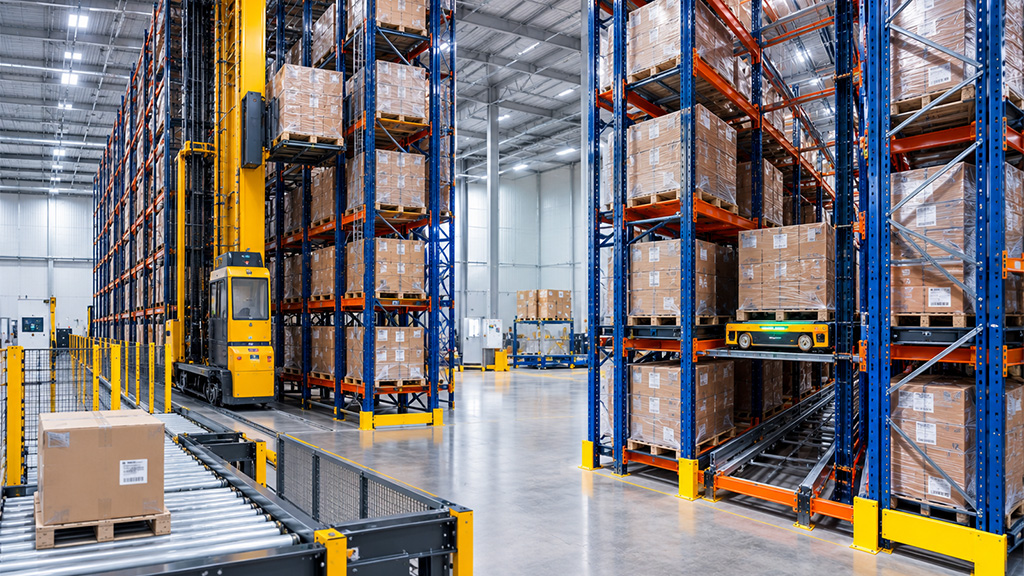
What Does ASRS Stand For?
ASRS stands for:
Automated Storage and Retrieval System.
The technology is designed to automate the storage and retrieval of goods within a warehouse or distribution facility.
Depending on the system design, ASRS can use technologies such as:
- Cranes
- Shuttles
- Lifts
- Conveyors
- Software controls
- Automated storage racks
Racks & Rollers currently offers both ASRS with Crane and ASRS with Shuttle as part of its automation portfolio.
How Does an ASRS Work?
A simplified ASRS process can look like this:
Goods arrive → Identification → Storage location assigned → Automated storage → Retrieval request → Automated retrieval → Dispatch/picking
The exact process varies depending on the system.
The key principle is that automated equipment handles the movement between storage locations and designated input/output points.
What Is ASRS With a Crane?
Crane-based ASRS uses automated storage and retrieval cranes to move loads vertically and horizontally within a racking structure.
This can allow warehouses to use significant vertical height while maintaining organized storage locations.
It can be particularly relevant to facilities requiring high storage density and structured automated movement.
What Is Shuttle-Based ASRS?
Shuttle-based ASRS uses automated shuttle vehicles to transport loads within storage lanes.
Racks & Rollers describes its shuttle-based ASRS as a fully automated solution designed for dense storage and high-intensity inventory operations.
Explore ASRS with Shuttle.
1. Better Use of Vertical Space
One of the major reasons businesses consider ASRS is the ability to utilize warehouse height.
Instead of limiting storage to conventional manual-accessible levels, automated equipment can operate within high storage structures.
This can be particularly valuable where warehouse floor space is expensive or limited.
2. High-Density Storage
ASRS can be designed around compact storage layouts.
By reducing the need for conventional forklift aisles in certain configurations, automated systems can potentially increase storage density.
The actual improvement depends on warehouse geometry, equipment and storage requirements.
3. Faster Storage and Retrieval
Automation can reduce the time associated with manual movement between storage locations.
Automated equipment can retrieve goods from predefined locations and transport them to designated areas.
This can be valuable in high-throughput operations.
4. Improved Inventory Accuracy
Because automated systems operate according to programmed storage locations and control logic, they can support structured inventory management.
Integration with warehouse management software can further improve visibility into inventory locations and movements.
5. Reduced Manual Material Movement
ASRS can reduce the amount of manual travel and forklift movement required for certain storage and retrieval processes.
This can help businesses redesign workflows around more controlled material movement.
6. Improved Scalability
As businesses grow, manual warehouse processes can become increasingly difficult to scale.
ASRS provides a technology platform that can support high-volume storage and retrieval operations.
However, the system should be designed around both current and projected throughput.
Is ASRS Suitable for Every Warehouse?
No.
ASRS can involve significant investment in infrastructure, equipment, software and maintenance.
It is generally more relevant where businesses have requirements such as:
- High inventory volume
- High throughput
- Space constraints
- High storage density requirements
- Repetitive storage/retrieval activity
- Long-term automation objectives
For smaller or low-throughput warehouses, conventional racking may be more appropriate.
ASRS vs Conventional Pallet Racking
| Factor | Conventional Pallet Racking | ASRS |
|---|---|---|
| Automation | Low/manual | High |
| Forklift dependence | Higher | Lower for automated processes |
| Storage density | Moderate to high | High depending on design |
| Investment | Generally lower | Generally higher |
| Throughput | Depends on MHE | Designed for automated throughput |
| Software integration | Optional | Typically important |
| Best suited for | Flexible manual operations | High-volume automated operations |
How Do You Know If ASRS Is Right for You?
Before investing in automation, analyse:
- Current throughput
- Future throughput
- SKU count
- Pallet dimensions
- Load weights
- Warehouse height
- Available floor area
- Required storage density
- Required retrieval speed
- Integration requirements
This assessment helps determine whether ASRS, shuttle systems, conveyors or conventional storage would be appropriate.
The Future of Warehouse Automation
Warehouses are increasingly becoming integrated environments where storage, material handling, software and data work together.
ASRS can form an important component of this ecosystem.
Racks & Rollers provides multiple automation technologies including conveyors, merge & sort, ASRS, vertical goods lifts, radio shuttle and pick/put-to-light system
Final Thoughts
ASRS can transform the way high-volume warehouses store and retrieve inventory.
However, automation should always start with the operational requirement.
The right system is the one that matches the warehouse’s throughput, storage profile, available space and long-term objectives.
Explore Racks & Rollers warehouse automation solutions or contact the team for an automation assessment.
FAQs
What does ASRS stand for?
ASRS stands for Automated Storage and Retrieval System.
Is ASRS suitable for small warehouses?
It can be, but the economics and operational requirements need to be evaluated carefully.
Does ASRS eliminate forklifts?
Not necessarily. The level of forklift reduction depends on the overall warehouse design and the type of ASRS implemented.