
Introduction
Warehouse racking systems are designed to store products efficiently, but every storage structure has specific load limitations. Understanding warehouse racking load capacity is essential for businesses that store heavy pallets, industrial components, raw materials and finished goods.
Incorrect assumptions about load capacity can create serious safety risks. Before installing or modifying a racking system, businesses should understand how loads are distributed and why the complete rack configuration matters.
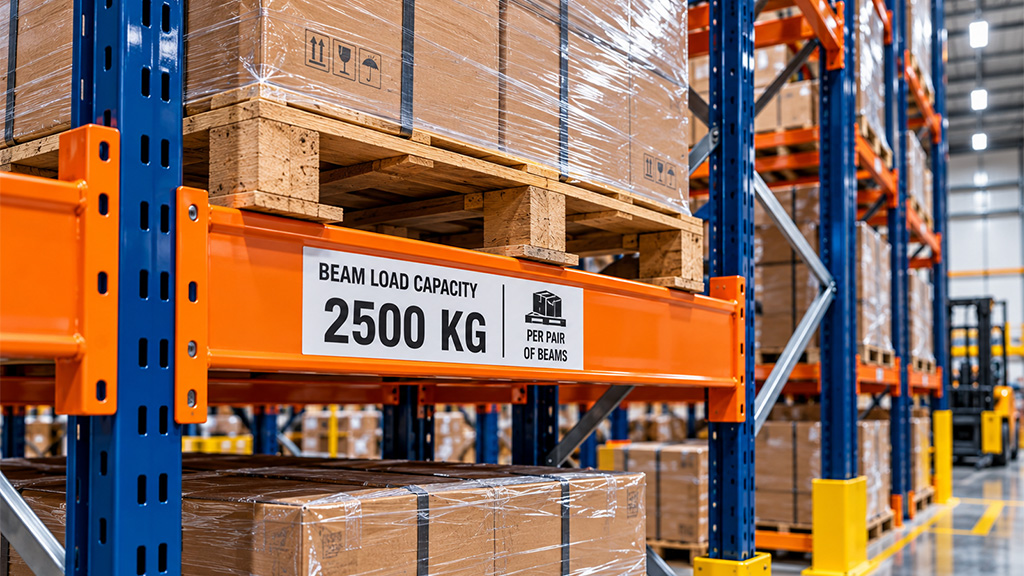
What Is Warehouse Racking Load Capacity?
Warehouse racking load capacity refers to the maximum load a rack component or complete rack configuration is designed to support under specified conditions.
It is important to distinguish between three terms.
1. Beam load capacity
This relates to the load a pair of beams can support under the specified design conditions. The permissible load depends on factors such as beam dimensions, span, material and loading arrangement.
2. Bay load capacity
A bay is a storage section between adjacent upright frames. Its capacity depends on the configuration of beams, storage levels, upright frames and the overall structural design.
3. Individual pallet load
This is the weight of a pallet and its contents. Every pallet position must be suitable for the intended load and loading arrangement.
A beam rating, a bay rating and an individual pallet weight are not interchangeable.
What Determines Rack Load Capacity?
Several factors influence the capacity of a warehouse racking system:
- Beam dimensions: Length, section geometry and material properties affect beam performance.
- Upright frames: Frame design, height, bracing and configuration influence structural capacity.
- Beam elevations: The position of storage levels can affect the behaviour of the upright frames.
- Load distribution: A uniformly distributed load behaves differently from a concentrated or uneven load.
- Pallet dimensions: Pallet size and the way it rests on the beams matter.
- Floor and anchoring conditions: The supporting floor and anchorage must be appropriate for the design.
- Operating environment: Forklift impacts, damaged components and modifications can affect safe operation.
These factors must be assessed together rather than in isolation.
How to Calculate the Weight Stored in a Pallet Position
For a simple inventory estimate:
Total stored load = Number of pallets × Gross weight per pallet
For example, if a storage level holds two pallets weighing 800 kg each, the total stored pallet load is 1,600 kg.
This is only an inventory calculation. It does not establish that the beam or rack is safe for that load. The permissible capacity must be confirmed against the engineered design and applicable load information.
Five Common Rack Loading Mistakes
- Storing heavier pallets than the system was designed for.
- Assuming all beam levels have identical capacity.
- Placing loads unevenly or outside the intended support positions.
- Changing beam elevations without checking the design.
- Continuing to use visibly damaged rack components without assessment.
How Can Businesses Improve Rack Safety?
Maintain clear load information, train warehouse operators, investigate forklift impacts, prohibit unauthorized modifications and arrange appropriate inspections.
For existing installations, Racks & Rollers Rack Inspection Services can help businesses assess their storage infrastructure.
If you are planning a new installation, explore industrial racking solutions designed around your load requirements and warehouse operations.
Conclusion
Understanding warehouse racking load capacity requires more than checking the weight of individual pallets. Beam ratings, upright frames, storage levels, load distribution and floor conditions all contribute to the complete system’s performance.
Always obtain capacity information for the actual rack configuration and have changes assessed by qualified professionals.
Need a storage solution designed around your loads?
Contact Racks & Rollers at www.racksandrollers.com or email info@racksandrollers.com.
Frequently Asked Questions
Can I increase rack capacity by adding more beams?
Not automatically. Additional beams change the configuration but do not necessarily increase every component’s permissible capacity. Obtain an engineering assessment before making modifications.
Does a heavier pallet always require a different rack?
Not necessarily. The existing system may be suitable if its approved design supports the load, but the actual configuration must be verified.
Why are rack load notices important?
They communicate the intended capacity and help operators avoid overloading the storage system.