
Introduction
Warehouse operations are becoming increasingly complex.
Businesses are handling more SKUs, higher order volumes and tighter delivery expectations while trying to control operating costs.
As a result, warehouse automation is becoming an important consideration for businesses looking to improve the way materials and inventory move through their facilities.
Warehouse automation does not necessarily mean completely removing people from the operation. Instead, automation can be used to improve repetitive processes, material movement, storage density and operational consistency.
Here are eight reasons businesses should consider warehouse automation.
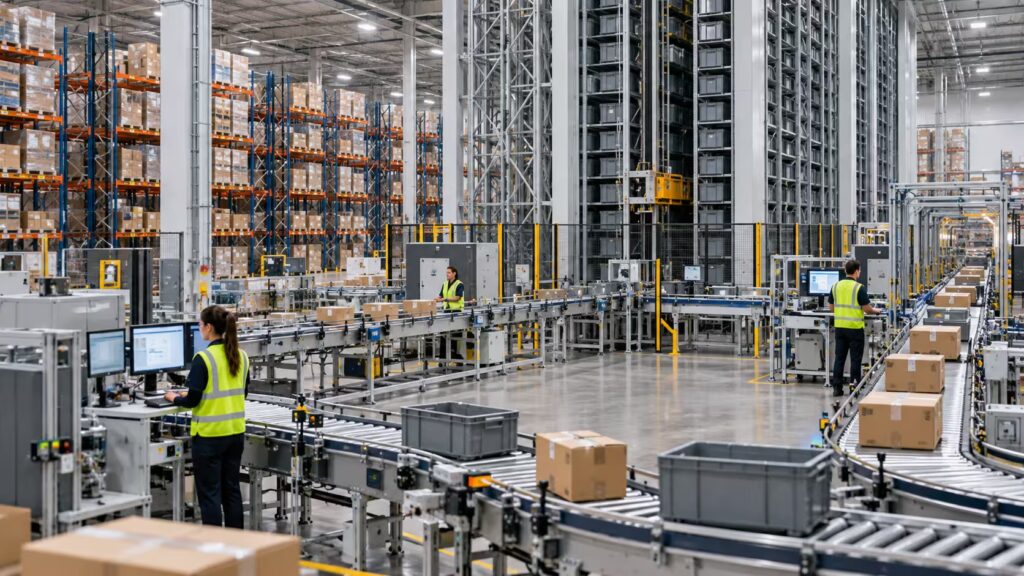
Reduce Unnecessary Manual Movement
Employees can spend a considerable amount of time walking, transporting and repositioning materials.
Automation technologies can reduce unnecessary manual movement by transporting goods between designated locations.
For example, conveyor systems can move cartons, totes or other materials between different warehouse processes.
Explore Racks & Rollers conveyor systems to learn more.
Improve Operational Efficiency
Automation can help streamline repetitive warehouse processes.
Depending on the application, automated systems can support:
- Material movement
- Storage and retrieval
- Sorting
- Picking
- Order consolidation
- Vertical movement
The objective is to create a smoother flow of materials through the warehouse.
Make Better Use of Warehouse Space
Land and warehouse space can represent a significant investment.
Automation can allow businesses to rethink how inventory is stored and moved.
Solutions such as automated storage and retrieval systems can use vertical space and structured storage locations to support higher-density operations.
Racks & Rollers provides ASRS solutions with crane and shuttle systems as part of its automation portfolio.
Support Higher SKU Volumes
As businesses expand, their number of SKUs may also increase.
More SKUs can create challenges in:
- Inventory organization
- Picking
- Storage
- Tracking
- Material movement
Warehouse automation can help businesses manage increasing operational complexity through structured and technology-enabled processes.
Improve Material Flow
Warehouse efficiency depends heavily on how materials move between different operational zones.
A typical warehouse may have:
Receiving → Storage → Picking → Sorting → Packing → Dispatch
Automation technologies can connect these areas and create more consistent material flow.
Conveyors, sortation systems and automated storage technologies can all contribute to an integrated warehouse environment.
Improve Workplace Ergonomics
Repeated lifting, carrying and walking can place physical demands on warehouse employees.
Automation can reduce unnecessary manual handling by moving materials mechanically or automatically between locations.
Vertical goods lifts, for example, can assist with movement between different warehouse levels.
Explore the Vertical Goods Lift solution from Racks & Rollers.
Improve Scalability
A warehouse that works efficiently at one level of demand may struggle when order volumes increase.
Automation can provide a framework for scaling certain operations.
The right solution depends on:
- Current throughput
- Future throughput
- SKU profile
- Product dimensions
- Available space
- Required storage density
- Budget
- Required level of automation
Automation should therefore be planned around business growth rather than implemented simply because it is technologically advanced.
Build a Future-Ready Warehouse
The warehouse of the future is likely to involve closer integration between storage, material handling, software and automation.
Businesses can consider technologies such as:
- ASRS
- Conveyors
- Radio shuttle systems
- Sortation
- Vertical goods lifts
- Pick-to-light
- Put-to-light
Racks & Rollers provides integrated warehouse automation solutions designed around different warehouse requirements.
Does Every Warehouse Need Automation?
No.
Automation should solve a specific operational problem.
A small warehouse with low throughput may not require extensive automation. A high-volume distribution centre with thousands of SKUs may benefit significantly from automated storage and material movement.
The correct approach is to first understand the operation and then identify where automation can create measurable value.
How to Know If Your Warehouse Is Ready for Automation
Consider these questions:
- Are employees spending excessive time moving materials?
- Is warehouse space becoming constrained?
- Are order volumes increasing?
- Are picking errors affecting operations?
- Is SKU complexity increasing?
- Are manual processes becoming difficult to scale?
- Do you need faster material movement?
- Are you planning a new distribution centre?
If several of these challenges apply to your business, it may be worth evaluating automation.
Final Thoughts
Warehouse automation is not about replacing every manual process.
It is about using technology where it can improve efficiency, consistency, storage utilization and material flow.
The best automation strategy starts with understanding the warehouse and identifying the processes that create the biggest operational challenges.
Racks & Rollers combines racking, shelving, automation, structural solutions and consulting to create integrated warehouse solutions.
Talk to Racks & Rollers about your warehouse automation requirements.