
Introduction
A warehouse can have modern storage racks, forklifts and well-organized inventory but still experience operational problems if stock information is inaccurate or warehouse activities are poorly coordinated.
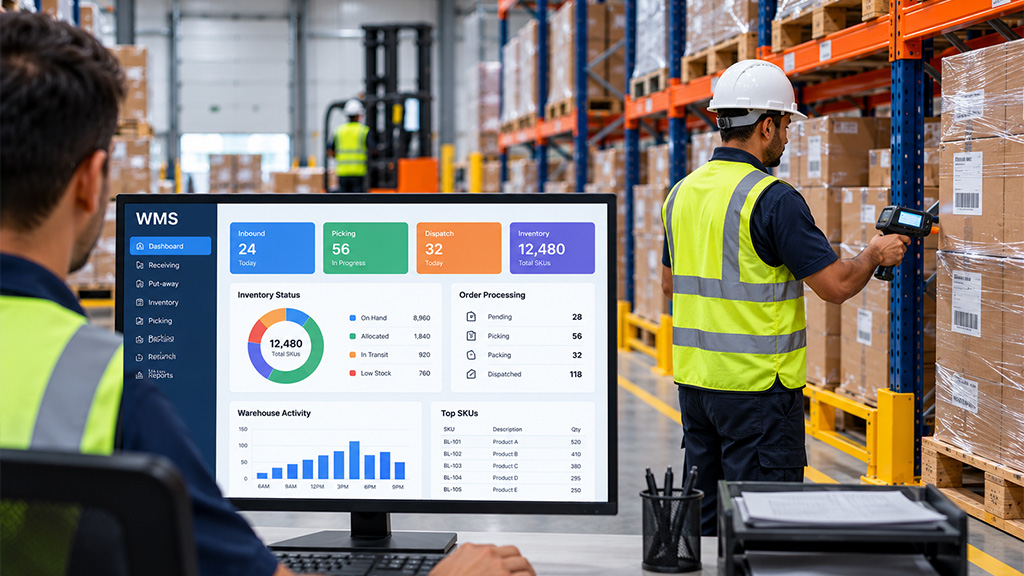
A Warehouse Management System (WMS) helps businesses manage and track warehouse operations through software.
From receiving incoming goods to locating inventory, processing picking tasks and confirming dispatch, a WMS can provide greater visibility into what is happening inside a warehouse.
What Is a Warehouse Management System?
A warehouse management system is software used to manage and coordinate warehouse activities.
Depending on the solution, it may support:
- Receiving and put-away
- Inventory tracking
- Storage location management
- Order picking
- Packing and dispatch
- Cycle counting
- Returns processing
- Warehouse performance reporting
A WMS can be especially useful when businesses handle multiple SKUs, frequent stock movements or complex distribution processes.
Racks & Rollers offers Warehouse Management System services as part of its consulting portfolio.
How Does a WMS Work?
Consider a simple example.
A shipment of 100 cartons arrives at a warehouse.
- The receiving team records the incoming shipment.
- The system updates the inventory record.
- A storage location is assigned according to configured rules.
- Warehouse staff move the cartons to that location.
- When an order arrives, the system identifies the inventory required.
- Picking and dispatch activities are recorded.
The exact workflow depends on the software, integrations and operating procedures.
Six Important WMS Features
1. Inventory visibility
A WMS can help staff identify recorded stock quantities and locations, reducing dependence on manual spreadsheets.
2. Put-away management
The system can suggest or assign storage locations using predefined rules, such as product type, available space or operational requirements.
3. Picking support
Picking tasks can be organized to help warehouse employees retrieve the correct products efficiently.
4. Barcode and scanning integration
Compatible barcode scanners and mobile devices can help capture stock movements and reduce manual data entry.
5. Cycle counting
Businesses can perform planned inventory checks and investigate differences between recorded and physical stock.
6. Reporting and analytics
A WMS may provide information on inventory accuracy, order processing, stock movement and other operational indicators.
WMS vs Warehouse Racking: What Is the Difference?
These two solutions address different problems.
Racking provides physical storage locations.
A WMS manages information and workflows associated with inventory and warehouse activities.
For example, a rack creates a physical pallet position. A WMS can record which product is assigned to that position and help manage its movement.
Explore Racks & Rollers warehouse racking solutions for the physical storage side of warehouse planning.
Does Every Warehouse Need a WMS?
Not necessarily. A small operation with limited inventory and straightforward processes may be able to work with simpler tools.
A WMS becomes worth evaluating when a business experiences:
- Frequent inventory discrepancies
- Increasing order volumes
- Multiple storage locations
- Growing SKU complexity
- Difficulties tracking stock movements
- Complex picking or replenishment requirements
- A need for more reliable operational reporting
How to Implement a WMS Successfully
Start by documenting existing warehouse processes. Clean up SKU data, standardize location labels and define how receiving, put-away, picking and dispatch should work.
Then evaluate software capabilities, integration requirements, hardware, staff training and reporting needs.
Software alone cannot correct a poorly defined warehouse process. The operating procedures, physical storage arrangement and data quality must work together.
Conclusion
A warehouse management system can help businesses improve inventory visibility, coordinate warehouse activities and make decisions using more reliable operational information.
The right solution depends on business size, SKU complexity, order volumes and integration requirements.
Explore Racks & Rollers Warehouse Management System services and Intralogistics Design to understand how warehouse processes, storage and information flow can be coordinated.
Looking to improve warehouse visibility and operational control?
Visit www.racksandrollers.com or email info@racksandrollers.com.
Frequently Asked Questions
What is the main purpose of a WMS?
Its main purpose is to manage and coordinate warehouse activities and provide visibility into inventory and stock movements.
Does a WMS improve inventory accuracy?
It can support better accuracy when combined with reliable data, scanning processes, staff training and regular inventory checks.
Can a WMS work with automated warehouse equipment?
Depending on the software and equipment, integrations may be possible. Compatibility and system requirements must be evaluated during planning.