
Introduction
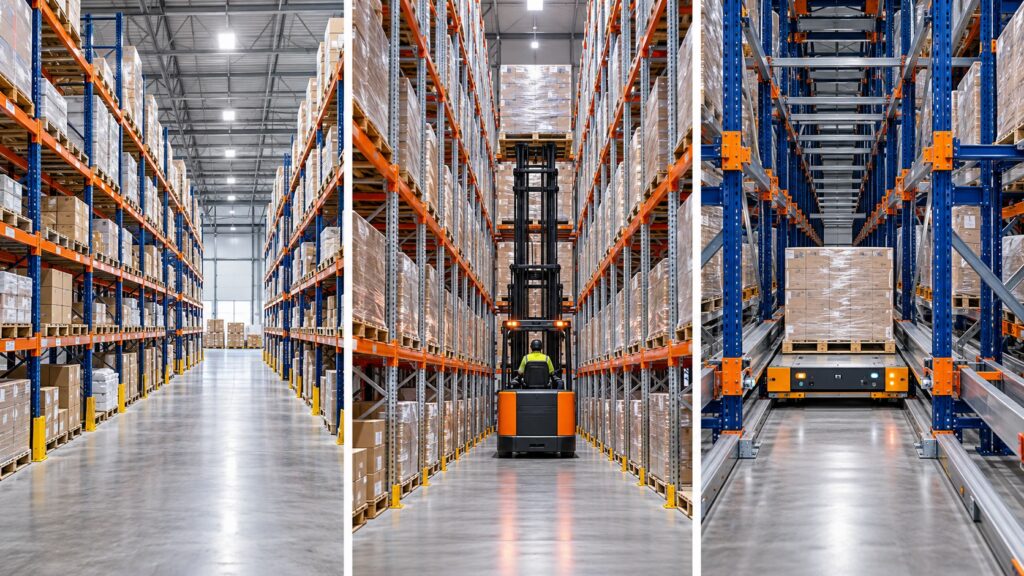
Selecting the right pallet racking system can have a major impact on warehouse capacity, inventory accessibility and operational efficiency.
Three commonly considered solutions are:
- Selective pallet racking
- Drive-in pallet racking
- Radio shuttle racking
Although all three are designed for palletized storage, they serve different operational requirements.
So which one is right for your warehouse?
The answer depends on your SKU profile, storage density requirements, accessibility, throughput and material handling strategy.
Selective Pallet Racking
Selective pallet racking is one of the most flexible warehouse storage solutions.
The system provides direct access to individual pallet positions, making it particularly useful for warehouses handling multiple SKUs.
Best suited for:
- Large SKU variety
- Frequent picking
- Direct pallet access
- Flexible storage requirements
- High SKU turnover
One of the major advantages is accessibility.
Warehouse operators can access an individual pallet without necessarily moving other pallets.
Racks & Rollers provides Selective Pallet Racking designed around different pallet sizes, loads and material handling requirements.
Drive-In Pallet Racking
Drive-in racking takes a different approach.
Instead of creating individual accessible pallet positions like selective racking, pallets are stored within deep lanes.
This can create a higher-density storage configuration for suitable products.
Best suited for:
- High-density storage
- Large quantities of similar products
- Lower SKU variety
- Bulk storage
- Suitable palletized goods
Drive-in racking can be particularly useful when storage density is more important than direct access to every pallet.
Explore the Drive-In Pallet Racking system from Racks & Rollers.
Radio Shuttle Racking
Radio shuttle racking adds a higher level of semi-automation to high-density pallet storage.
A shuttle device moves pallets within deep storage lanes, reducing the need for forklifts to travel into the storage lanes for every storage and retrieval operation.
Best suited for:
- High-density storage
- Higher throughput
- Repetitive pallet movement
- Operations seeking semi-automated storage
- Warehouses where forklift travel should be reduced
Racks & Rollers offers Radio Shuttle Racking as part of its warehouse storage and automation solutions.
Selective vs Drive-In vs Radio Shuttle
| Factor | Selective | Drive-In | Radio Shuttle |
|---|---|---|---|
| Direct pallet access | Excellent | Limited | Limited |
| Storage density | Moderate | High | High |
| SKU variety | High | Lower | Medium/High depending on design |
| Automation level | Manual | Manual | Semi-automated |
| Forklift access | Aisle-based | Into lanes | Primarily aisle-based |
| Best use | Flexible storage | Bulk storage | High-density/high-throughput storage |
*Actual performance depends on warehouse design, inventory characteristics and equipment.
Which System Gives the Highest Storage Density?
If maximum density is the primary objective, drive-in and radio shuttle systems may be more suitable than selective racking.
However, maximum density should not automatically be treated as the best solution.
A warehouse that stores thousands of different SKUs may need accessibility more than maximum density.
This is why storage density must always be evaluated together with operational requirements.
Which System Is Best for Multiple SKUs?
Selective pallet racking is generally well suited to warehouses with a wide range of SKUs because individual pallet positions can be accessed directly.
This makes it useful for businesses where inventory variety and picking accessibility are important.
Which System Is Best for High-Density Storage?
Drive-in and radio shuttle systems are designed to support higher-density storage configurations.
The right option depends on factors such as throughput, pallet characteristics, required automation and operational processes.
What About FIFO and LIFO?
Inventory rotation is another important consideration.
Different racking systems support different inventory movement strategies.
For example, Racks & Rollers also provides Pallet Flow Racking for applications where FIFO-oriented storage is important.
This demonstrates why choosing a pallet racking system should start with the business process rather than the rack itself.
How Should You Choose?
Before selecting a pallet racking system, evaluate:
- Number of SKUs
- Number of pallets
- Pallet dimensions
- Pallet weight
- Inventory turnover
- Required accessibility
- Required storage density
- Warehouse height
- Forklift type
- Future growth
A professional warehouse storage consultant can analyse these factors and develop a suitable layout.
Final Verdict
There is no universal winner between selective, drive-in and radio shuttle racking.
Choose selective racking when accessibility and SKU flexibility are priorities.
Choose drive-in racking when high-density bulk storage is the primary requirement.
Choose radio shuttle racking when high-density storage needs to be combined with greater operational efficiency and semi-automation.
The right answer depends on your warehouse.
Explore the complete range of pallet racking solutions from Racks & Rollers or request a customized warehouse layout.