
Introduction
When planning a new warehouse or upgrading an existing facility, one of the first questions businesses ask is: how much does a warehouse racking system cost?
The answer depends on several variables.
Two warehouse projects with similar floor areas can require very different storage systems because they may have different load requirements, SKU profiles, rack heights, equipment, safety provisions and installation conditions.
Understanding these factors helps buyers compare quotations more accurately and avoid selecting a solution based on price alone.
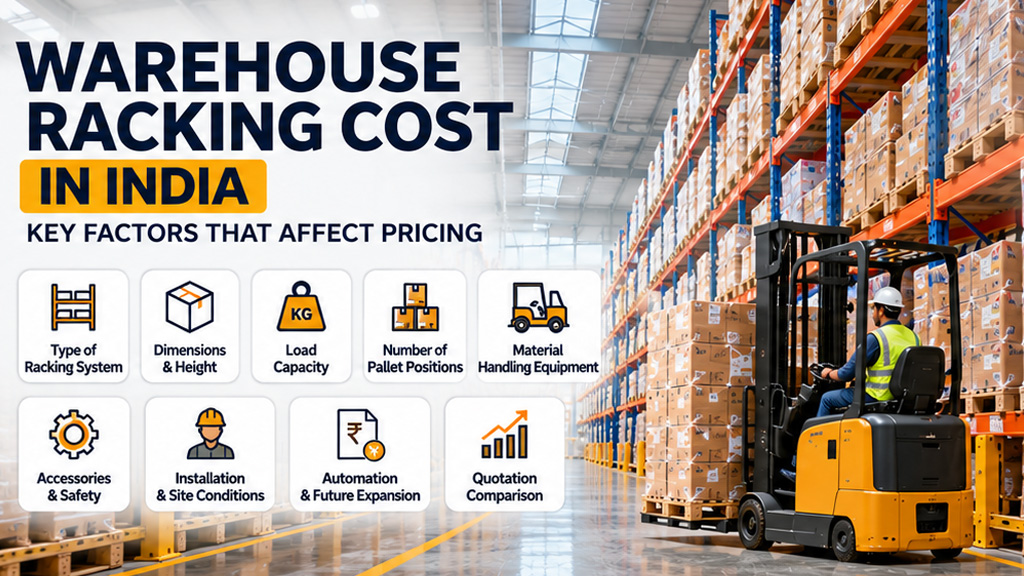
1. Type of Racking System
The storage configuration is one of the main factors influencing project cost.
For example:
- Selective pallet racking: Provides direct access to individual pallet positions.
- Drive-in racking: Provides dense storage for suitable bulk-storage applications.
- Push-back racking: Uses a lane-based arrangement for multi-deep pallet storage.
- Pallet flow racking: Uses gravity-fed roller lanes.
- Radio shuttle racking: Incorporates a shuttle device for pallet movement.
- Mobile pallet racking: Uses movable rack structures to reduce permanently open aisles.
These systems differ in their components, operating methods and engineering requirements.
Explore Racks & Rollers Racking Solutions to understand the available configurations.
2. Warehouse Height and Rack Dimensions
Rack height, bay width, depth and number of storage levels influence the amount of material required and the engineering design.
A quotation should reflect the actual warehouse dimensions and required pallet positions rather than relying only on the total floor area.
3. Load Capacity Requirements
The intended load per pallet and the complete rack configuration affect the specification of beams, upright frames and related components.
Heavy loads may require different structural sections and engineering considerations from lighter applications.
Buyers should provide accurate pallet weights and dimensions so that quotations can be based on the actual requirement.
4. Number of Pallet Positions
The total number of required storage positions affects the quantity of rack components.
However, more positions do not necessarily mean a proportionately lower cost per position. Rack configuration, equipment requirements and project complexity can change the overall economics.
5. Material Handling Equipment
The rack layout must suit the equipment used to store and retrieve products.
Forklifts, reach trucks and very-narrow-aisle equipment can have different aisle and operating requirements.
A storage system should be evaluated together with its handling equipment to avoid creating an unsuitable layout.
6. Accessories and Safety Components
Depending on the design, a project may require items such as:
- Row spacers
- Column protection
- Frame protection
- Pallet supports
- Safety barriers
- Mesh decking
- Load signage
- Other specified accessories
The required components depend on the application, design and operating environment.
7. Installation and Site Conditions
Installation costs may depend on warehouse location, access, floor conditions, installation height, project schedule and other site-specific requirements.
The quotation should clarify what is included in supply and installation and identify any exclusions.
8. Automation and Future Expansion
A manual storage system and a semi-automated or fully automated solution have different investment requirements.
If automation is planned for the future, the warehouse design should consider the relevant space, interfaces and operational requirements early in the project.
This does not mean every warehouse should automate. The business case should be evaluated using the actual storage and throughput requirements.
9. How to Compare Warehouse Racking Quotations
| Factor | What to Verify |
|---|---|
| Storage capacity | Number of usable pallet or shelf positions |
| Design | Dimensions and configuration |
| Load requirements | Design loads and capacity information |
| Scope | Supply, installation and included components |
| Accessories | Required protection and safety items |
| Site work | Any additional site-specific requirements |
| Documentation | Drawings and relevant design information |
| Warranty and support | Terms offered by the supplier |
| Expansion | Compatibility with the proposed future configuration |
*A lower quotation is not necessarily the best value if it omits important components or does not meet the operational requirements.
10. Information to Share When Requesting a Quote
To obtain a more useful quotation, prepare:
- Warehouse dimensions and clear height.
- Pallet dimensions.
- Gross pallet weight.
- Number of SKUs.
- Required pallet positions.
- Forklift or handling equipment details.
- Storage and retrieval requirements.
- Warehouse location.
- Any special environmental conditions.
- Expected future expansion.
The more accurate the information, the easier it is for the supplier to assess the appropriate solution.
Conclusion
Warehouse racking cost in India depends on the storage system, engineering requirements, load capacity, dimensions, equipment, accessories and installation scope.
Instead of comparing quotations solely on price, businesses should evaluate the complete system against their storage needs and operating conditions.
Racks & Rollers provides industrial racking solutions and pallet racking solutions for different warehouse requirements.
Looking for a warehouse racking quotation?
Visit www.racksandrollers.com or email info@racksandrollers.com with your warehouse dimensions, pallet specifications and storage requirements.
Frequently Asked Questions
What is the price of warehouse racking in India?
There is no single price that applies to every warehouse. Cost depends on the type of racking, dimensions, load requirements, number of positions, accessories and installation scope. A project-specific quotation is the most reliable way to establish the cost.
Is heavy-duty racking more expensive than light-duty storage?
It can be, because the design and components may need to accommodate higher loads. The actual cost depends on the complete configuration and specifications.
How can I reduce warehouse racking costs?
Start with accurate inventory and load data, evaluate alternative storage configurations, optimize the layout and compare quotations with equivalent specifications. Avoid compromising engineering or safety requirements to reduce the initial purchase price.