
Introduction
Effective inventory management is not just about knowing how much stock a warehouse holds. Businesses must also know which products should be issued first.
This becomes particularly important when inventory has a shelf life, an expiry date or a defined production sequence.
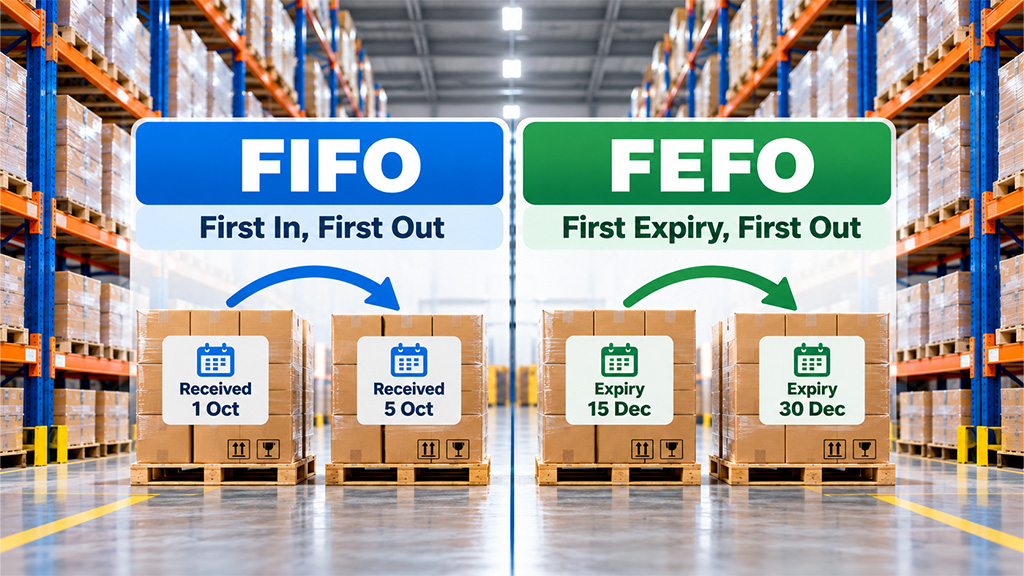
Two common inventory rotation methods are FIFO (First In, First Out) and FEFO (First Expiry, First Out). Although they may appear similar, they use different criteria to determine which stock should be dispatched first.
What Is FIFO in Inventory Management?
FIFO stands for First In, First Out.
Under this method, inventory received first is generally issued or dispatched before inventory received later.
For example, a warehouse receives 100 cartons on 1 October and another 100 cartons on 5 October. Under a FIFO policy, the earlier receipt would generally be issued first, assuming both batches are eligible for dispatch.
FIFO is useful when the order of receipt is an appropriate basis for stock rotation.
What Is FEFO in Inventory Management?
FEFO stands for First Expiry, First Out.
Under this method, inventory with the earliest expiry date is prioritized for dispatch, regardless of which batch arrived first.
For example:
| Batch | Receipt Date | Expiry Date |
|---|---|---|
| Batch A | 1 October | 30 December |
| Batch B | 5 October | 15 December |
Although Batch A arrived earlier, Batch B has the earlier expiry date. Under FEFO, Batch B would generally be prioritized, subject to quality status, customer requirements and any applicable restrictions.
This distinction makes FEFO particularly relevant when expiry dates differ between batches.
FIFO vs FEFO: Key Differences
| Factor | FIFO | FEFO |
|---|---|---|
| Selection criterion | Receipt sequence | Expiry date |
| Main objective | Rotate older receipts first | Prioritize earliest-expiring eligible stock |
| Expiry tracking | Useful where applicable | Essential to the method |
| Common applications | General inventory rotation | Products with expiry dates |
| Data requirements | Receipt dates and stock records | Expiry dates, batch records and stock status |
Which Industries Use FIFO and FEFO?
These methods can be useful across different industries.
FMCG: FEFO may be appropriate for packaged products with varying expiry dates.
Food and beverage: Expiry, freshness and product-specific handling rules can influence stock rotation.
Pharmaceuticals: Batch traceability, expiry dates and regulatory requirements can make FEFO important where applicable.
Manufacturing: FIFO may support orderly consumption of materials, while expiry-sensitive inputs may require additional controls.
The appropriate method should be determined by product characteristics, quality requirements and business procedures.
How Do Racking Systems Support Stock Rotation?
The physical storage arrangement can affect how easily warehouse staff follow a rotation policy.
For example, pallet flow racking uses gravity-fed lanes and can support FIFO movement when configured and operated appropriately.
However, a racking system alone does not guarantee correct expiry management. Batch identification, location records, stock status and warehouse procedures must also be maintained.
How Can a Warehouse Implement FEFO?
- Record expiry dates accurately when receiving stock.
- Maintain batch or lot identification.
- Assign eligible inventory to defined storage locations.
- Use warehouse software or documented procedures to prioritize the earliest-expiring stock.
- Check expiry dates during picking and dispatch.
- Place expired, damaged or quarantined stock on the appropriate hold.
- Review stock approaching expiry and take action according to company policy.
Common Stock Rotation Mistakes
- Recording receipt dates but not expiry dates.
- Mixing batches without maintaining traceability.
- Picking the nearest pallet instead of the correct eligible batch.
- Failing to update records after stock movements.
- Treating FIFO and FEFO as interchangeable.
- Relying on software without accurate physical stock records.
Conclusion
FIFO and FEFO both support inventory rotation, but they solve different problems.
FIFO prioritizes the order in which stock arrived. FEFO prioritizes the expiry date of eligible stock.
Businesses should select the method that matches their products, quality requirements and operational processes, then support it with accurate inventory records and appropriate storage arrangements.
Explore Racks & Rollers Warehouse Management System services and pallet flow racking solutions.
Looking to improve stock rotation in your warehouse?
Visit www.racksandrollers.com or email info@racksandrollers.com.
Frequently Asked Questions
Is FEFO better than FIFO?
Neither method is universally better. FEFO is particularly useful when expiry dates determine dispatch priority, while FIFO is appropriate when receipt sequence is the intended rotation rule.
Can a warehouse use both FIFO and FEFO?
Yes. Different products or processes may require different inventory rotation rules.
Does pallet flow racking automatically ensure FEFO?
No. It can support FIFO movement, but FEFO requires expiry-date visibility and appropriate inventory selection procedures.