
Introduction
A warehouse is much more than a building where products are stored. It is an operational environment where receiving, storage, picking, movement and dispatch must work together efficiently.
One of the simplest ways to improve warehouse operations is to rethink how inventory is stored.
Modern industrial storage racks can help businesses organize inventory, use vertical space more effectively and create a more structured material flow.
Here are seven important ways industrial racking can improve warehouse efficiency.
Better Utilization of Available Space
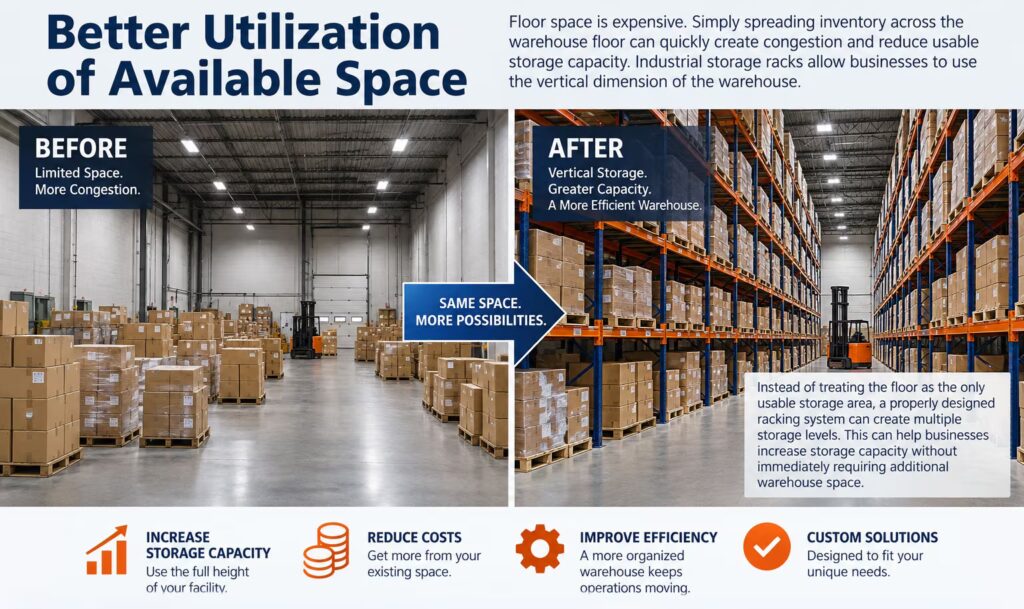
Floor space is expensive.
Simply spreading inventory across the warehouse floor can quickly create congestion and reduce usable storage capacity.
Industrial storage racks allow businesses to use the vertical dimension of the warehouse.
Instead of treating the floor as the only usable storage area, a properly designed racking system can create multiple storage levels.
This can help businesses increase storage capacity without immediately requiring additional warehouse space.
Explore Racks & Rollers industrial racking solutions for custom-designed warehouse storage systems.
Improved Inventory Organization
A warehouse becomes difficult to manage when products do not have clearly defined storage locations.
Racking systems can provide dedicated locations for inventory, making it easier for warehouse teams to identify where products should be stored and retrieved.
Better organization can also support:
- Faster picking
- Easier stock identification
- Improved housekeeping
- Better inventory visibility
- More structured warehouse operations
Faster Picking and Handling
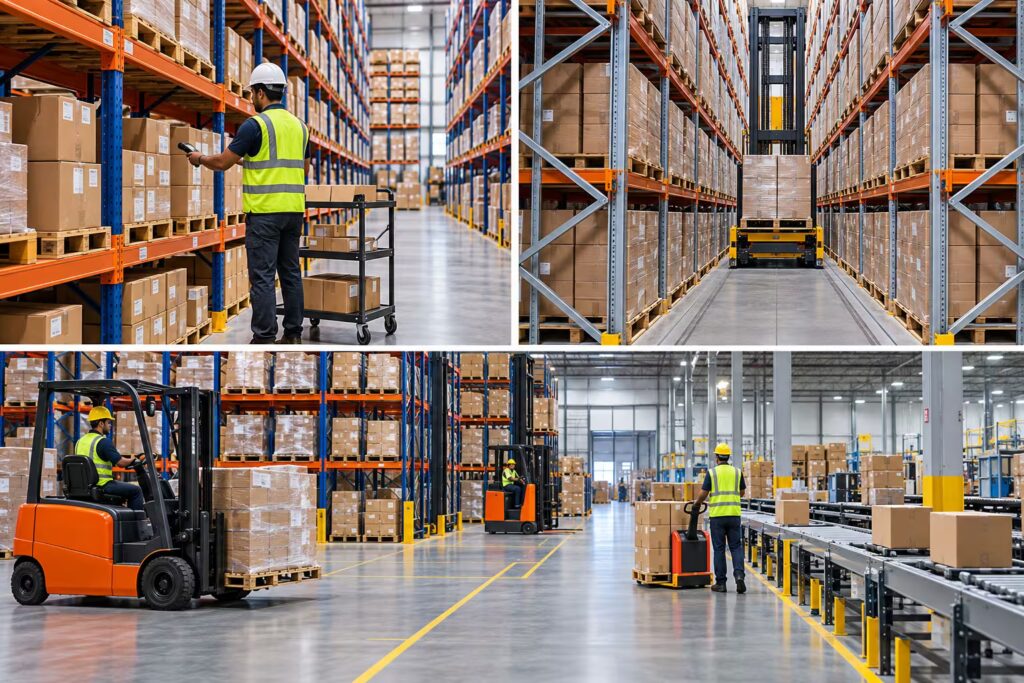
Warehouse efficiency is closely connected to how quickly employees can locate and move inventory.
A properly planned storage layout can reduce unnecessary movement and create logical product locations.
For businesses with high SKU turnover, accessibility becomes particularly important.
For example, selective pallet racking is designed to provide direct access to individual pallet locations.
More Storage Density
Different warehouse operations require different levels of storage density.
Some businesses prioritize direct access to every pallet, while others need to maximize the amount of inventory stored within a limited area.
Systems such as drive-in, push-back, mobile and radio shuttle racking can be considered when higher density is a priority.
The right choice depends on inventory characteristics and operational requirements.
Better Integration With Material Handling Equipment
Industrial storage racks do not operate independently.
They need to work with forklifts, reach trucks, pallet trucks and other material handling equipment.
A properly engineered warehouse layout can coordinate:
- Rack dimensions
- Aisle widths
- Storage heights
- Forklift movement
- Loading areas
- Picking areas
This creates a more efficient flow of materials throughout the facility.
Easier Warehouse Expansion
Business growth often means more inventory.
If the warehouse storage system has not been planned for scalability, expansion can become difficult.
Modular and properly engineered racking systems can make it easier to adapt storage configurations as business requirements change.
This is particularly important for growing e-commerce, FMCG, automotive, pharmaceutical and manufacturing operations.
A Strong Foundation for Warehouse Automation
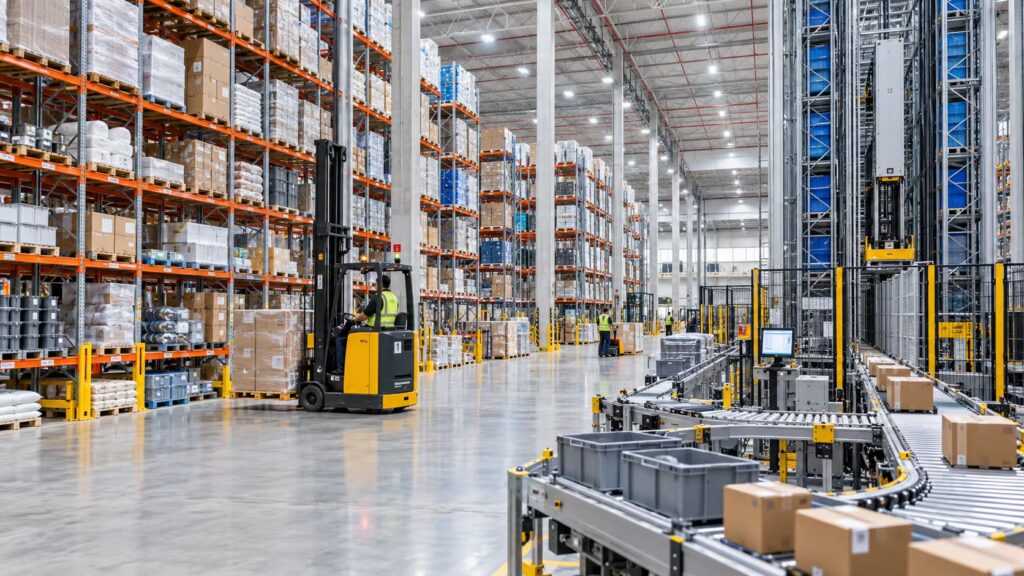
Racking can also become part of a larger automated warehouse strategy.
Modern warehouses may integrate storage with:
- Conveyors
- ASRS
- Shuttle systems
- Automated sorting
- Vertical goods lifts
- Pick-to-light systems
For example, conveyor systems can facilitate continuous movement of materials between different areas of a warehouse.
When storage and automation are designed together, businesses can create a more coordinated intralogistics operation.
Choosing the Right Industrial Storage Racks
The biggest mistake is choosing racks based only on load capacity or price.
A proper storage solution should consider:
- Product dimensions
- Product weight
- Number of SKUs
- Inventory turnover
- Picking frequency
- Available floor area
- Available vertical height
- Material handling equipment
- Required storage density
- Future business growth
This is why professional warehouse design starts with understanding the operation.
Industrial Racking for Different Industries
Industrial storage racks can be used across a wide range of industries.
These include:
- Manufacturing
- Automotive
- FMCG
- Pharmaceuticals
- E-commerce
- Retail
- Logistics
- Cold storage
Each industry may have different storage, accessibility and throughput requirements.
Final Thoughts
Industrial storage racks can have a significant impact on warehouse operations when they are properly designed around the business.
The objective should not simply be to fit more racks into a warehouse.
The objective should be to create a storage system that improves space utilization, accessibility, inventory organization and material flow.
Racks & Rollers provides customized storage and warehousing solutions based on warehouse layout, SKU profile and operational requirements.