
Introduction
A warehouse may contain hundreds or thousands of SKUs, but not every item has the same financial importance or operational impact.
Some items account for a large share of inventory consumption value, while many others contribute relatively little.
ABC analysis in warehouse inventory management helps businesses classify inventory into categories so that attention and control can be prioritized appropriately.
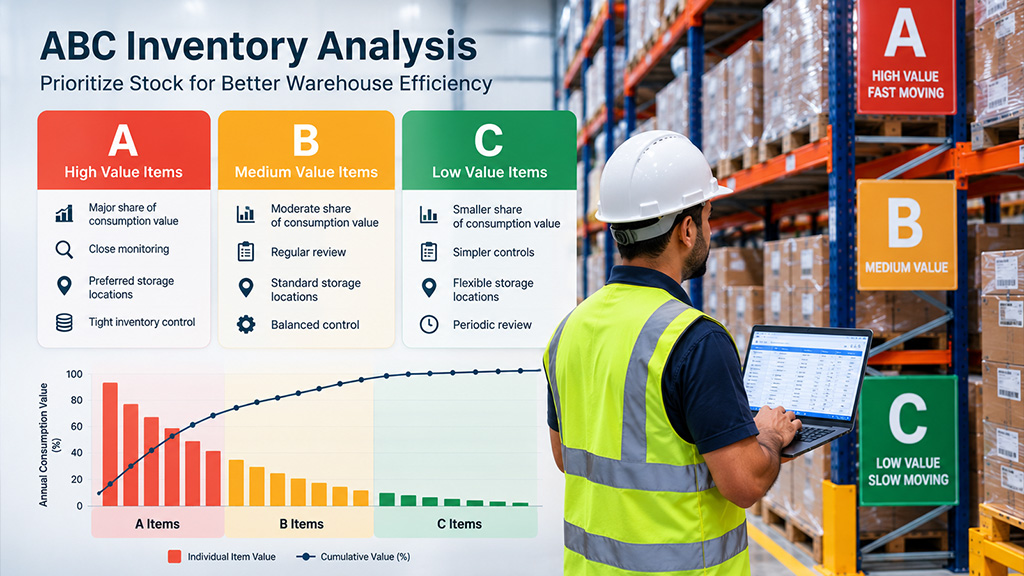
What Is ABC Inventory Analysis?
ABC analysis is an inventory classification method that groups items according to their relative importance.
A common approach uses annual consumption value, calculated as:
Annual consumption value = Annual quantity consumed × Unit cost
The method typically divides items into three categories.
A items
These items account for a relatively large share of total consumption value and often receive closer monitoring.
B items
These items have intermediate importance and generally receive a moderate level of control.
C items
These items contribute a smaller share of total consumption value and may be managed using simpler controls, where appropriate.
The exact percentage boundaries depend on the business and its inventory profile. ABC analysis should not be treated as a universal fixed-percentage rule.
A Simple ABC Analysis Example
| Product | Annual Consumption | Unit Cost | Annual Consumption Value |
|---|---|---|---|
| Product A | 1,000 units | ₹500 | ₹5,00,000 |
| Product B | 2,000 units | ₹100 | ₹2,00,000 |
| Product C | 5,000 units | ₹10 | ₹50,000 |
In this example, Product A has the highest annual consumption value, even though it has the lowest annual quantity consumed among the three products.
This demonstrates why quantity alone is not enough to determine inventory importance.
In a real ABC analysis, all relevant SKUs would be ranked by annual consumption value and grouped according to the company’s chosen classification thresholds.
How to Conduct ABC Analysis
Step 1: Prepare the inventory data
Collect SKU codes, annual consumption quantities and unit costs for a consistent period.
Step 2: Calculate annual consumption value
Multiply annual consumption quantity by unit cost for every SKU.
Step 3: Rank the SKUs
Sort the items from highest to lowest annual consumption value.
Step 4: Calculate cumulative value
Calculate each item’s share of total consumption value and the cumulative share as you move down the ranked list.
Step 5: Assign categories
Use documented business-specific thresholds to classify items into A, B and C categories.
Step 6: Review regularly
Repeat the analysis periodically because demand, prices and product portfolios change.
How Can ABC Analysis Improve Warehouse Operations?
ABC analysis can help businesses prioritize cycle counting, inventory reviews and replenishment attention.
It can also inform storage decisions. Frequently picked items may benefit from convenient picking locations, although the final location should also consider product dimensions, weight, safety and order patterns.
For example, ABC analysis can be combined with warehouse location data and order frequency to create a more informed storage strategy.
A well-organized physical storage system, such as industrial racking, supports the execution of these decisions.
Limitations of ABC Analysis
ABC analysis based only on consumption value may overlook other important factors.
A low-value component may be critical to production. A product with expiry restrictions may require special handling. Demand variability and supplier lead times can also affect stocking decisions.
Businesses may therefore combine ABC analysis with other classifications, such as criticality, demand variability or expiry sensitivity.
Conclusion
ABC analysis provides a practical method for prioritizing inventory according to its relative consumption value.
When combined with reliable inventory records, suitable storage locations and regular reviews, it can help warehouse teams direct attention towards the items that matter most.
Explore Racks & Rollers Warehouse Management System services for support with warehouse processes and inventory management.
Want to improve warehouse inventory control?
Visit www.racksandrollers.com or email info@racksandrollers.com.
Frequently Asked Questions
What does ABC stand for in inventory management?
ABC refers to three inventory categories—A, B and C—used to prioritize items according to their relative importance.
Is ABC analysis based on product quantity?
A common approach uses annual consumption value rather than quantity alone. Other classification criteria may be used where the business requires them.
How often should ABC analysis be updated?
The review frequency should reflect how quickly the inventory profile changes. Businesses may review it periodically and whenever major product or demand changes occur.