
Introduction
A warehouse design may look efficient on a drawing but perform differently when real operations begin.
Forklifts may queue at busy aisles, packing stations may become bottlenecks, and material movement may take longer than expected.
Warehouse simulation helps businesses study these potential issues by modelling warehouse processes and testing different operating scenarios before committing to major changes.
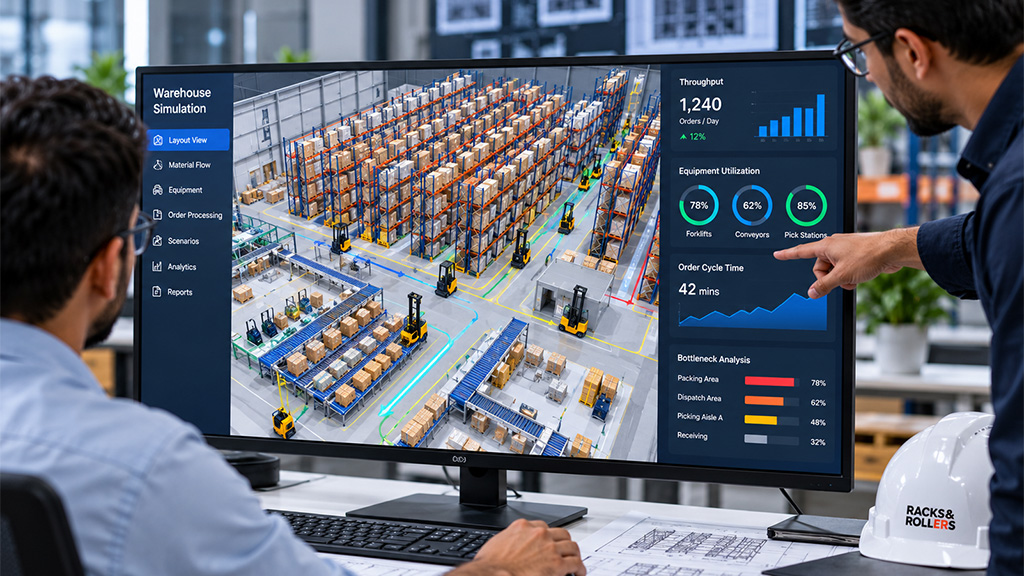
What Is Warehouse Simulation?
Warehouse simulation uses a computer-based model to represent warehouse activities, equipment, inventory movement and operational rules.
Depending on the method, a simulation can represent processes such as:
- Goods receiving
- Put-away
- Storage and retrieval
- Picking
- Conveying
- Packing
- Dispatch
- Equipment movement
- Queues and congestion
The model can then be used to evaluate how the proposed system may behave under specified assumptions.
Racks & Rollers offers Warehouse Simulation services.
How Does Warehouse Simulation Work?
A typical simulation project follows these steps.
Step 1: Collect operational data
The project team gathers information such as order volumes, SKU profiles, inventory quantities, equipment specifications and operating schedules.
Step 2: Build the model
The warehouse layout, storage systems, workstations and relevant operating rules are represented in the model.
Step 3: Define scenarios
The team creates scenarios to evaluate, such as normal demand, peak demand, additional equipment or alternative operating rules.
Step 4: Run the simulation
The model processes the specified activities and estimates performance under the chosen assumptions.
Step 5: Compare results
Alternative scenarios can be compared to identify potential bottlenecks and opportunities for improvement.
Five Problems Warehouse Simulation Can Help Investigate
- Congestion: Are certain aisles or workstations likely to become bottlenecks?
- Equipment requirements: How might the number or type of handling equipment affect throughput?
- Peak demand: Can the proposed operation handle expected demand surges under the modelled conditions?
- Storage and retrieval flow: How do different storage technologies affect material movement?
- Workstation capacity: Are picking, packing or dispatch areas likely to constrain overall performance?
The value comes from testing assumptions before implementing costly changes.
Warehouse Simulation vs a 3D Warehouse Drawing
A 3D drawing can communicate dimensions, equipment placement and the physical appearance of a warehouse.
A simulation can go further by representing time-dependent activities, movement, queues and operating rules.
Not every 3D model is a simulation, and not every simulation requires a visually detailed 3D environment.
The appropriate approach depends on the decision being evaluated.
What Data Is Needed?
Useful information may include:
- Warehouse dimensions
- Storage configuration
- SKU and order profiles
- Receiving and dispatch volumes
- Equipment speed and capacity
- Shift patterns
- Process times
- Travel routes
- Operating constraints
The more realistic the input assumptions, the more useful the results are likely to be. Simulation results remain estimates, not guarantees of actual performance.
When Should a Business Consider Simulation?
Simulation may be useful before constructing a new distribution centre, introducing automation, expanding storage capacity or redesigning a complex material handling operation.
It can also help compare alternatives when several equipment or process configurations appear viable.
Conclusion
Warehouse simulation gives businesses a structured way to test operational scenarios before implementing a physical design.
It can support better planning by revealing potential bottlenecks, comparing alternatives and clarifying the assumptions behind investment decisions.
Explore Racks & Rollers Warehouse Simulation and Intralogistics Design Services.
Planning a warehouse expansion or automation project?
Visit www.racksandrollers.com or email info@racksandrollers.com.
Frequently Asked Questions
Why is warehouse simulation useful?
It helps teams evaluate operational scenarios and potential bottlenecks before implementing a physical design.
Can simulation estimate warehouse throughput?
Yes, a properly developed model can estimate throughput under defined assumptions. Actual results may differ if operating conditions change.
Does warehouse simulation replace engineering?
No. Simulation supports decision-making but does not replace structural engineering, equipment design, safety reviews or commissioning.